


Table of Contents
I’m here to answer one simple question: How big does Gorr get? The God Butcher looks at the whole board — so how much power can we expect him to get from our opponents?
I’m gonna answer that… with ✨data✨. Let’s get into it.
How Big Do We Want Gorr to Get?
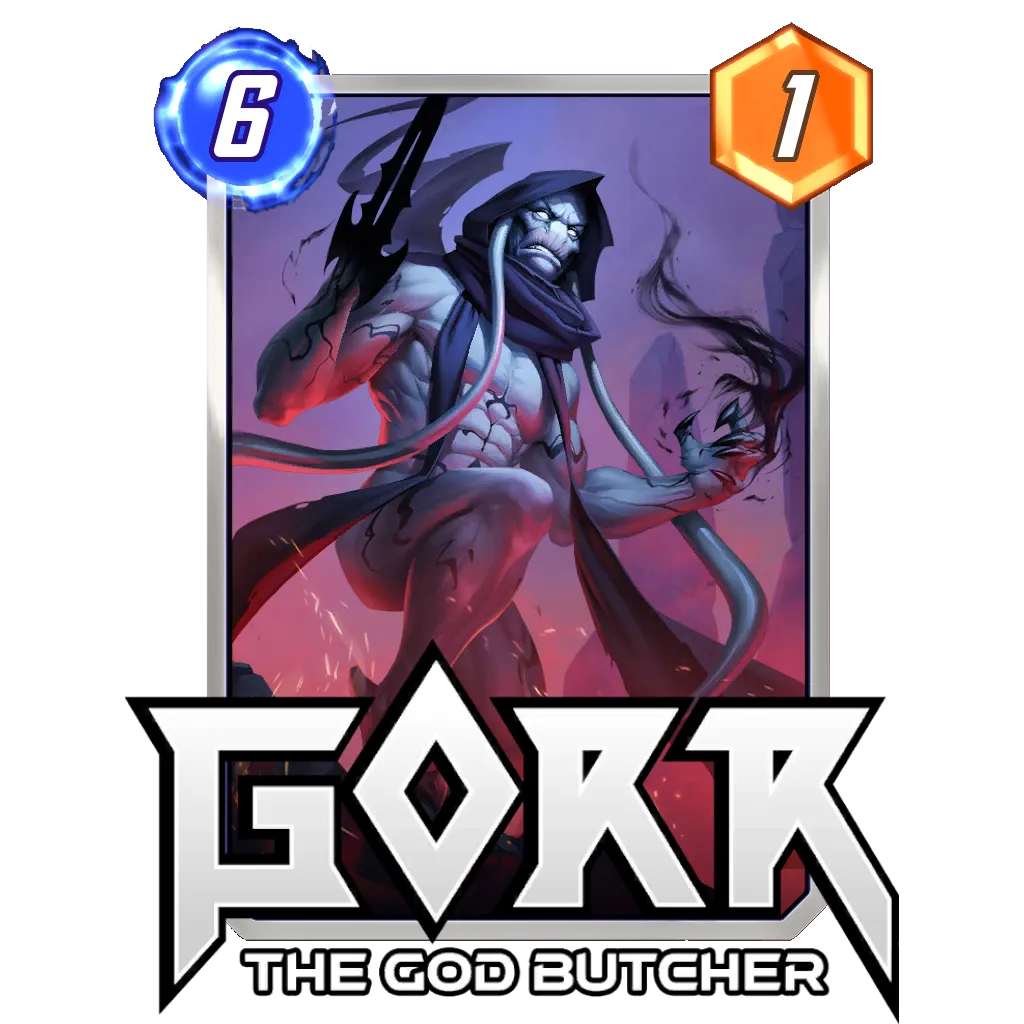
Gorr’s a 6/-1 with the text: “Ongoing: +2 Power for EACH On Reveal Card in play.” Look at him!










 Decks with Gorr the God Butcher
How big does Gorr need to get for us to want to play him? den already answered this beautifully earlier today. If you’re into theorycrafting, be sure to check out his thoughts on Gorr, plus some day 1 deck ideas. Now, let’s stand on the shoulders of giants to do some extra theorycrafting.
Generally speaking, we’re not doing anything with Gorr’s ability beyond making him a big ol’ stat stick. den thought 13 Power was a worthy goal. Keeping in mind I am generally not a fan of 6-cost cards — I’d agree 13’s when it catches my eye. I’m taking 15 seriously. 17’s when it’s hard to ignore.
So… we’re looking for 7–9 On Reveals on the board. We’re in control of our side of the board, but how many can we expect from our opponents? It’s data time.
State of the Meta: On Reveal Tally
I dug into data from our Marvel Snap Tracker. To get the most diverse data set, I looked at our users’ opponents. Besides being a much larger data set, it also removes the selection bias of only looking at the sort of players who would run a tracker. To get the level of detail I need, I’m limited to the last week of data. It’s a big enough sample size — tens of thousands of data points. Just wanted to note that it’s it’s representative of the recent meta (which is arguably a good thing).
I’ll specify the sub-sets of data I’m looking at as we go, but here are some criteria I’m always looking for:
- Nobody retreated
- At least 3 cards on the opponent’s side
- Game ended on Turn 6+ (the TVA is not Gorr’s friend)
Ranked vs. Conquest
Unsurprisingly, Ranked and Conquest display very similar distributions for how many On Reveals the opponents had. Here’s what it looked like in 6-turn games:

And some basic stats for how many opponent On Reveals we can expect:
| Mode | Median | Average |
|---|---|---|
| Ranked | 3 | 3.49 |
| Conquest | 3 | 3.52 |
Pre-Infinite vs. Post-Infinite
The difference between Pre- and Post-Infinite is even smaller than the difference between game modes. Since we’re looking at opponents, there are certainly bots included in the Pre-Infinite data. Once again, this chart covers 6-turn games:

| Rank | Median | Average |
|---|---|---|
| Pre-Infinite | 3 | 3.48 |
| Post-Infinite | 3 | 3.54 |
Turn 6 vs. Turn 7
Magik might be worth considering alongside Gorr, especially in Negative decks. It’s an extra draw and seven extra energy for both players to spend on On Reveal cards. Of course, she’s an On Reveal card herself.
This combines all ranks of Ranked and Conquest to help with sample size. We already saw that player rank and game mode had only a small influence on the distribution curve:

| Game Length | Median | Average |
|---|---|---|
| 6 Turns | 3 | 3.50 |
| 7 Turns | 4 | 4.31 |
If you wanted to see these with only Post-Infinite Ranked data, I gotchu:

| Game Length | Median | Average |
|---|---|---|
| 6 Turns | 3 | 3.54 |
| 7 Turns | 4 | 4.27 |


 Decks with Magik





 Decks with Mister Negative
Is Magik worth it? Seems like Limbo could reliably give Gorr 4 more Power. You’ll probably need to play Gorr on Turn 7 to keep him both secret (we want your opponent to play more On Reveals!) and safe. I doubt 4 extra Power is worth it unless you’re doing other cool combo things — like the previously mentioned Mister Negative.
Doing Your Part
Here are the numbers behind the chart for the Post-Infinite Ranked group. Below it, I’ll highlight some broad observations.
| Enemy On Reveal Cards | % of 6-Turn Games | % of 7-Turn Games |
|---|---|---|
| 0 | 2.39% | 0.85% |
| 1 | 8.68% | 5.30% |
| 2 | 18.30% | 11.66% |
| 3 | 23.95% | 17.63% |
| 4 | 20.80% | 20.06% |
| 5 | 13.75% | 18.74% |
| 6 | 7.02% | 12.98% |
| 7 | 3.23% | 7.10% |
| 8 | 1.33% | 3.75% |
| 9 | 0.44% | 1.48% |
| 10 | 0.09% | 0.38% |
| 11 | 0.03% | 0.05% |
| 12 | 0.00% | 0.02% |
In a 6-turn game, the most common numbers (in order) are: 3, 4, 2, 5, 1, 6, 7, 0, 8, 9, 10, 11, 12.
You can expect your opponent to have at least 4 On Reveal cards in ~46.7% of games, at least 3 in ~70.6%, and at least 2 in ~88.9%.
If we’re playing like an average player ourselves, there’ll be 6–7 On Reveals on the board. Gorr will have 11–13 Power. Not bad, but I don’t think it’s quite good enough for Gorr to be the universal best dumb stats. Red Hulk will sometimes be better, depending on your deck.
Of course, we can build for Gorr. If we want 15-power Gorrs, we should be bringing 5 of our own On Reveals to the party. That seems extremely doable to me, but it’s a bit above average — you’ll need to build for it! den’s article has a bunch of great decks for this. I think his Kate/Hammers deck will easily drop 7 of its own On Reveals — 6/19 Gorr, anyone?
Conclusion
I think the main takeaway from this little data dive is just having some evidence for what many intuited. Gorr can get big, and you can reasonably expect your opponent to provide about 6 of his Power. You’ll need to consider your deck makeup before just throwing Gorr in, but the bar is low. He’ll be the premier big 6-drop in decks that can reliably play 5 On Reveals.
Let me know what you think about these short data dives. Or Gorr! And if you haven’t yet, don’t forget to check out den’s theorycrafting for Gorr.



More Content